
The Future Skills Children Need: What Global Experts Agree On
From critical thinking and creativity to empathy and resilience, the world's leading organisations agree that future success depends on far more than academic knowledge alone.
Parents often ask what skills their children will need to succeed in an increasingly uncertain world. While there is no shortage of predictions about the future, it is revealing to examine what leading international organisations actually identify as essential competencies.
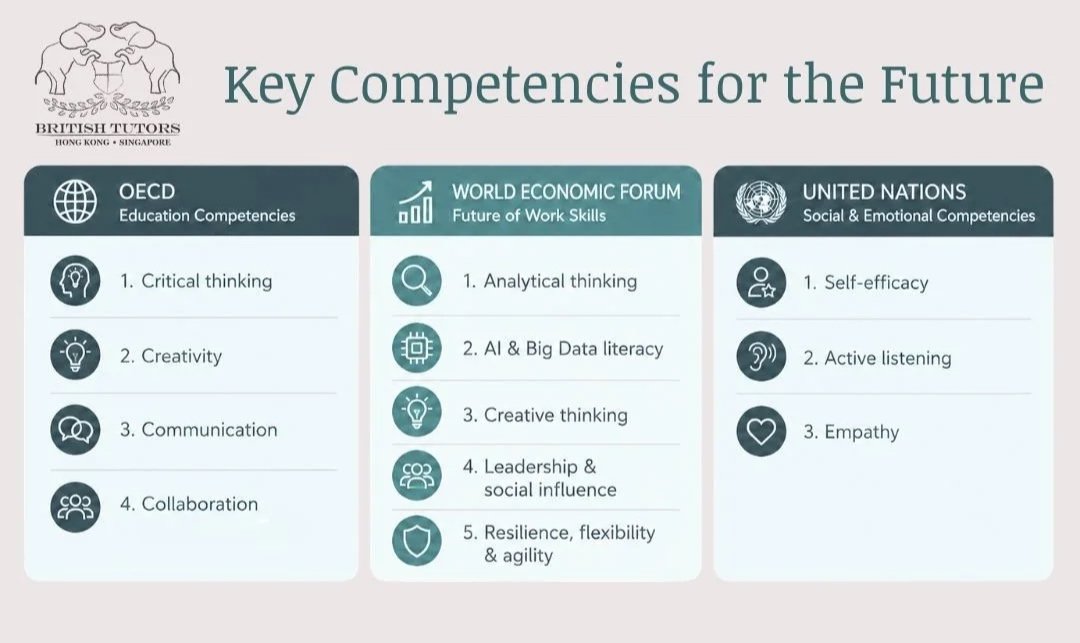
The OECD (Organisation for Economic Co-operation and Development), World Economic Forum and United Nations approach education from different perspectives, yet their frameworks point to a remarkably similar conclusion: future success will depend not only on what children know, but on how they think, communicate, collaborate and adapt.The overwhelming emphasis is on distinctly human capabilities.
Theme 1: Learning How to Think
The OECD identifies critical thinking and creativity as essential competencies, while the World Economic Forum highlights analytical thinking and creative thinking among the most important skills for the future workforce.
In an age where information is available instantly and AI can generate answers in seconds, the ability to evaluate evidence, question assumptions and form independent judgements has become increasingly valuable. The challenge for today's children is no longer simply acquiring knowledge; it is learning how to assess information, identify reliable sources and apply their understanding to unfamiliar situations.
Creativity is equally important. Whether developing innovative solutions, approaching problems from new angles or generating original ideas, creativity enables young people to contribute something uniquely human in a world where routine tasks are increasingly automated.
Theme 2: Learning How to Work With Others
While academic achievement remains important, all three frameworks emphasise the significance of interpersonal skills.
The OECD highlights communication and collaboration, while the United Nations places importance on active listening and empathy. The World Economic Forum adds leadership and social influence to the mix.
Together, these competencies recognise a simple truth: few meaningful achievements happen in isolation. Whether participating in a group project, leading a team, navigating a workplace or contributing to a community, success increasingly depends on the ability to work effectively with others.
Children who can listen carefully, communicate clearly, understand different perspectives and collaborate productively are likely to be better equipped for both personal and professional success.
Theme 3: Learning How to Adapt
The future is difficult to predict. Many of today's children will enter careers that do not yet exist, using technologies that have yet to be invented.
For this reason, adaptability features prominently within international skills frameworks. The United Nations highlights self-efficacy: the belief in one's ability to achieve goals and overcome challenges. Similarly, the World Economic Forum identifies resilience, flexibility and agility as critical competencies for the future.
These qualities enable young people to respond positively to setbacks, embrace change and continue learning throughout their lives. In a rapidly evolving world, the ability to adapt may prove just as important as any specific body of knowledge.
A Surprising Conclusion
Perhaps the most surprising finding is what does not dominate these frameworks. Despite widespread discussion of technology, only one of the competencies identified across the three organisations is explicitly technical: AI and Big Data.
The overwhelming emphasis is on human capabilities: thinking critically, communicating effectively, collaborating with others, demonstrating empathy and adapting to change.
For parents, this offers an important reminder. Academic achievement remains vital, but the most future-ready education is one that develops the whole child. The competencies identified by the OECD, World Economic Forum and United Nations suggest that success in the decades ahead will depend not only on knowledge, but on the ability to think independently, work effectively with others and respond confidently to an ever-changing world.